
Chapter 3: Planetary Darkening – When the World Stops Shining
Draft for Discussion

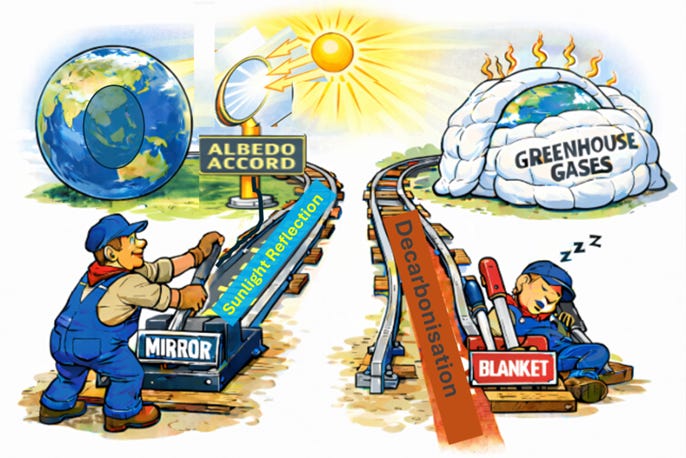
A good way to picture climate policy is to imagine two big levers that we can pull to change the planetary temperature. One lever works a blanket and the other works a mirror. Cutting the greenhouse gases that trap outgoing heat is the blanket lever. Slowing the thickening of the greenhouse blanket is the main focus of current climate policy. The second lever, the mirror, increases the white surfaces that brighten the planet by reflecting sunlight back to space.
Most climate debate has fixated on the blanket, on the theory that cutting emissions is the only way to slow global warming. This chapter explains that restoring the planetary mirror is a far more tractable, effective, safe and business-friendly climate lever.
Over the last two decades, satellites and ocean measurements have revealed that the Earth has darkened by 2% this century. This should be headline news in every boardroom. The darkening of our planetary sunlight mirror is now, on one calculation, causing five times more heating than the direct greenhouse effect from new emissions. And the rate of darkening is now five times faster than just two decades ago, with no sign that this acceleration will slow down. We are reflecting less sunlight and absorbing more, due mainly to feedback processes caused by the warming from emissions. Darkening is now a major driver of extra heating on top of the greenhouse effect – and it is happening on business-relevant timescales.
How bright is a healthy planet?
NASA measures how much of the sunlight that hits the Earth bounces straight back to space. The proportion reflected is known as albedo. Sunlight reflects mainly off bright surfaces such as clouds, ice, snow, aerosols and sand. The absorbed radiation heats up the oceans, land and atmosphere and is eventually re-emitted to space as heat.
An ice sheet covered in fresh snow has a high albedo. Open ocean and pine forests are dark and have a low albedo. Clouds sit in between, but because they cover so much of the planet and are often very bright, they are crucial to how much sunlight we absorb or reflect.
For decades albedo was mostly a theoretical number. Now we have systems that measure the whole planet’s energy budget in real time. Satellites carry instruments for a NASA program called Clouds and the Earth’s Radiant Energy System (CERES).[1] Combined with other satellite and ocean sensor networks, CERES continuously tracks how much sunlight comes in, how much light is reflected back out, and how much heat (infrared) the Earth emits.
The dangerous trend is that, since the early 2000s, the balance has shifted strongly toward more absorption. Most of that shift is because the planet is reflecting less sunlight – the mirror is dulling.
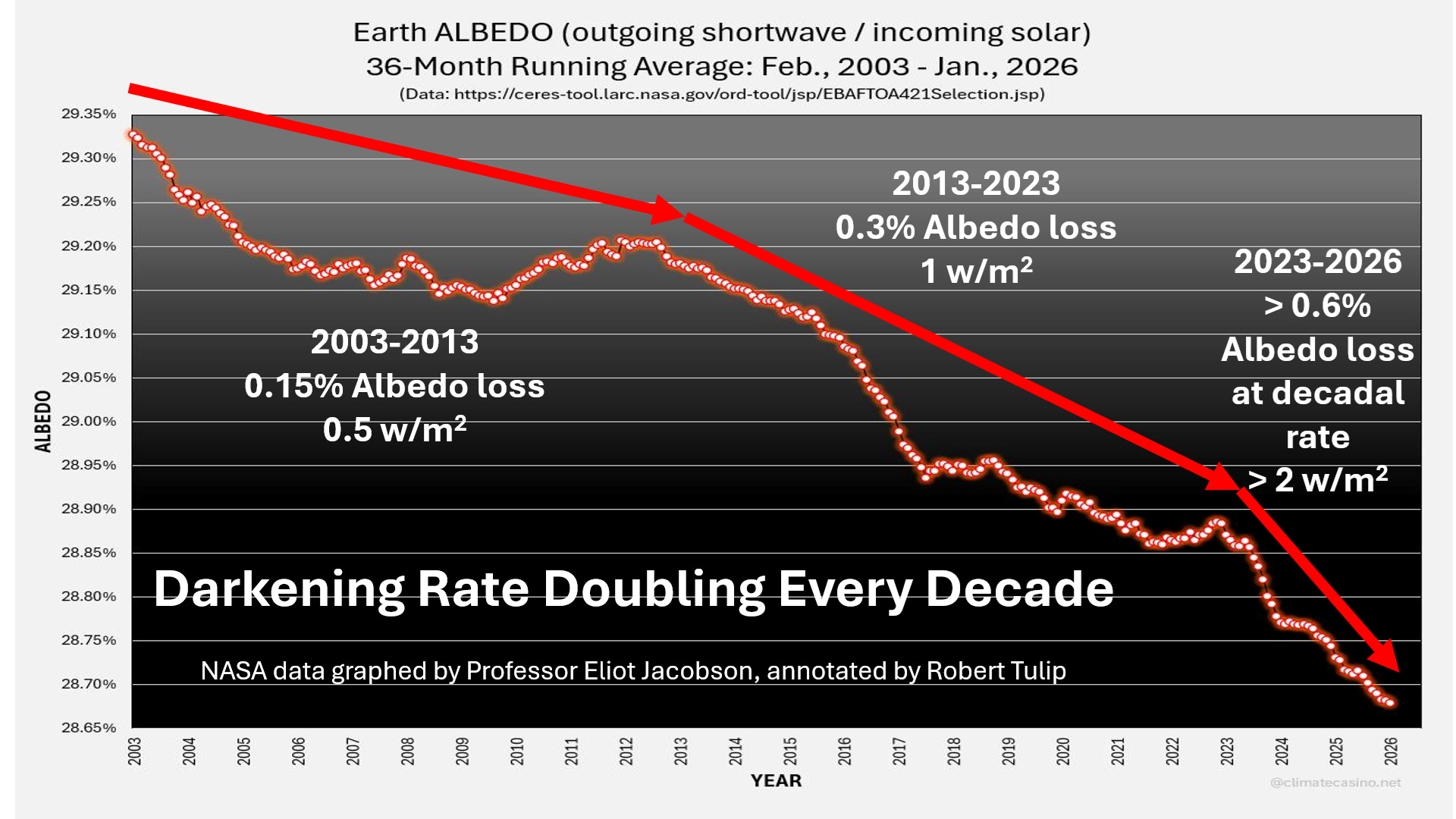
This chart made from CERES data shows the steady accelerating decline of planetary albedo since 2003
.
Earth receives a constant 340 watts per square metre of energy from the Sun. This chart shows that in 2003, 29.33% of that energy bounced back to space. This reflectivity ratio, termed planetary albedo, is mainly due to large bright surfaces such as clouds, ice, snow and atmospheric aerosols. Planetary albedo is now declining at an accelerating rate, five times faster than twenty years ago.
All that extra incoming solar radiation is absorbed by the Earth, creating accelerating warming feedback processes. A warmer planet makes clouds evaporate and ice melt. The sunlight that used to reflect back to space from these bright surfaces is now absorbed by the dark ocean and earth. That in turn causes more evaporation and melting. With a microphone and amplifier, feedback can destroy the speaker if allowed to continue. Loss of albedo means we face similar feedback risks at planetary scale.
The calculation that albedo feedbacks now cause five times as much warming as the greenhouse effect from new emissions is based on the observation that the greenhouse effect from new emissions adds about 0.04 w/m2 to planetary heating each year.[2] This latest CERES data confirms that the current annual albedo heating rate is now over 0.2 w/m2. 0.2 = 0.04 x 5. That means albedo loss is causing five times as much direct heating as new emissions. Albedo feedbacks outstrip greenhouse forcings five to one. The Pareto Principle in economics suggests that 20% of causes often produce 80% of effects, and that it is most efficient to focus on these main causes. Unfortunately in climate policy we do the opposite.
Since 2003, the satellite data shows an albedo fall from 29.33 to 28.68%. That fall of 0.65% in the albedo ratio shows that the planet is now more than 2% darker than in 2003, with reflectivity falling by more than two watts per square metre, from about 100 to 98 w/m2. Scientist James Hansen calculated the albedo loss in the decade since 2015 is equivalent to an extra 110 parts per million of CO2 emissions, vastly accelerating heating. It takes forty years to add 110 ppm of CO2, but albedo loss has delivered equivalent heating in the last decade.
The hidden heat surge: Loeb’s CERES analysis
Dr. Norman Loeb is NASA’s Principal Investigator for CERES. In 2021, Dr Loeb and colleagues analysed CERES satellite data together with ocean heat measurements from a fleet of robotic instruments called Argo floats.[3] These sensors drift with the ocean currents and move up and down between the surface and a mid-water level, providing an extensive evidence base to confirm the heating measured by satellites. The findings from these systematic measurements were very disturbing. The rate of Earth’s heating had doubled since 2005.
In the mid-2000s, the planet was gaining on the order of 0.4 watts of extra heat per square metre, averaged over the whole surface. Sunlight delivers a constant 340 w/m² of energy, as already mentioned. Loeb’s analysis of the whole system showed that the amount of energy leaving the Earth as light and heat combined was only 339.6 w/m². This small 0.4-watt excess of incoming over outgoing energy is known as radiative forcing. By the late 2010s it had doubled to 0.8 w/m², in just over a decade. This sudden recent doubling of radiative forcing is a key measure of how global warming is speeding up.
Half a watt may sound small, but spread over the entire planet, it is enormous. The surface of the Earth covers 500 trillion square metres. The constant extra incoming heat now compared to 2005 is therefore 200 terawatts (trillions). We usually measure industrial scale energy in megawatts (millions) and gigawatts (billions). By comparison, all 12,000 power stations in the USA together put out just over one terawatt. So the extra planetary heating just this century is equivalent to hundreds of thousands of large power stations running flat-out, 24/7, with nowhere for the waste heat to go, except into the air and sea, unless we work out how to send it out to space.
Dr Loeb’s team showed the extra heat came partly from the greenhouse “blanket” getting thicker, due to new emissions, but mostly from a decline in reflected sunlight. Less low cloud, less ice and snow, and less aerosols are all making the planet darker. In other words: the mirror has started to fail.
When storm-cloud belts shrink
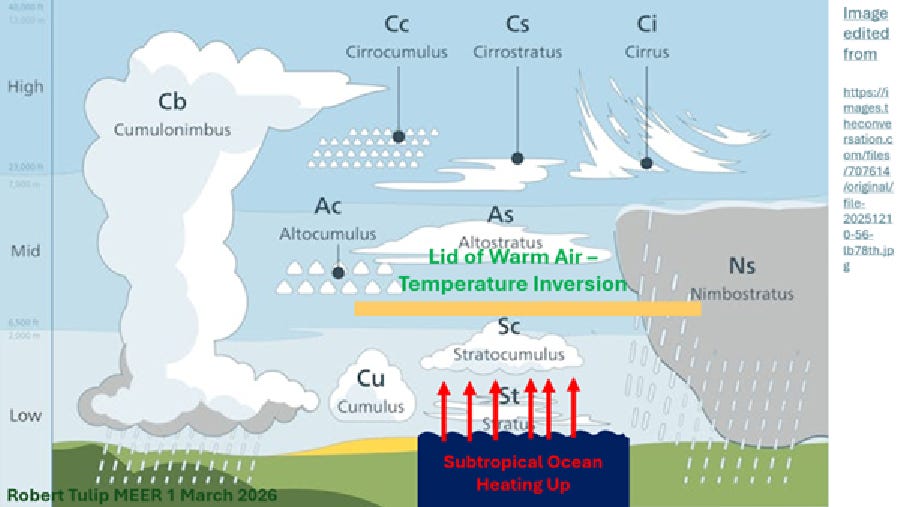
With all that extra heat going into the ocean, the air above the ocean is also warmer, which has destabilised cloud systems. In locations where cold deep ocean currents upwell next to continents, the oceans cool the surface air and create clouds that are held in place by a lid of warmer air above. This lid means these clouds spread out into vast low stratocumulus banks above the deep ocean, instead of forming high fluffy cumulus clouds. But when the ocean water warms, so does the surface air. Less low surface clouds form, and they evaporate faster
.
A 2025 study[4] led by NASA scientist George Tselioudis dug further into how ocean heat has created a “missing driver” of planetary darkening. Where exactly is the extra sunlight being absorbed? The team combined CERES satellite data with other detailed cloud observations to find out.
Their key finding was that the bright storm-cloud zones that ring the mid-latitudes have shrunk in size and shifted toward the poles. This large-scale reorganisation of the atmosphere has reduced overall cloud cover in key regions, allowing more sunlight to reach the darker ocean surface below.
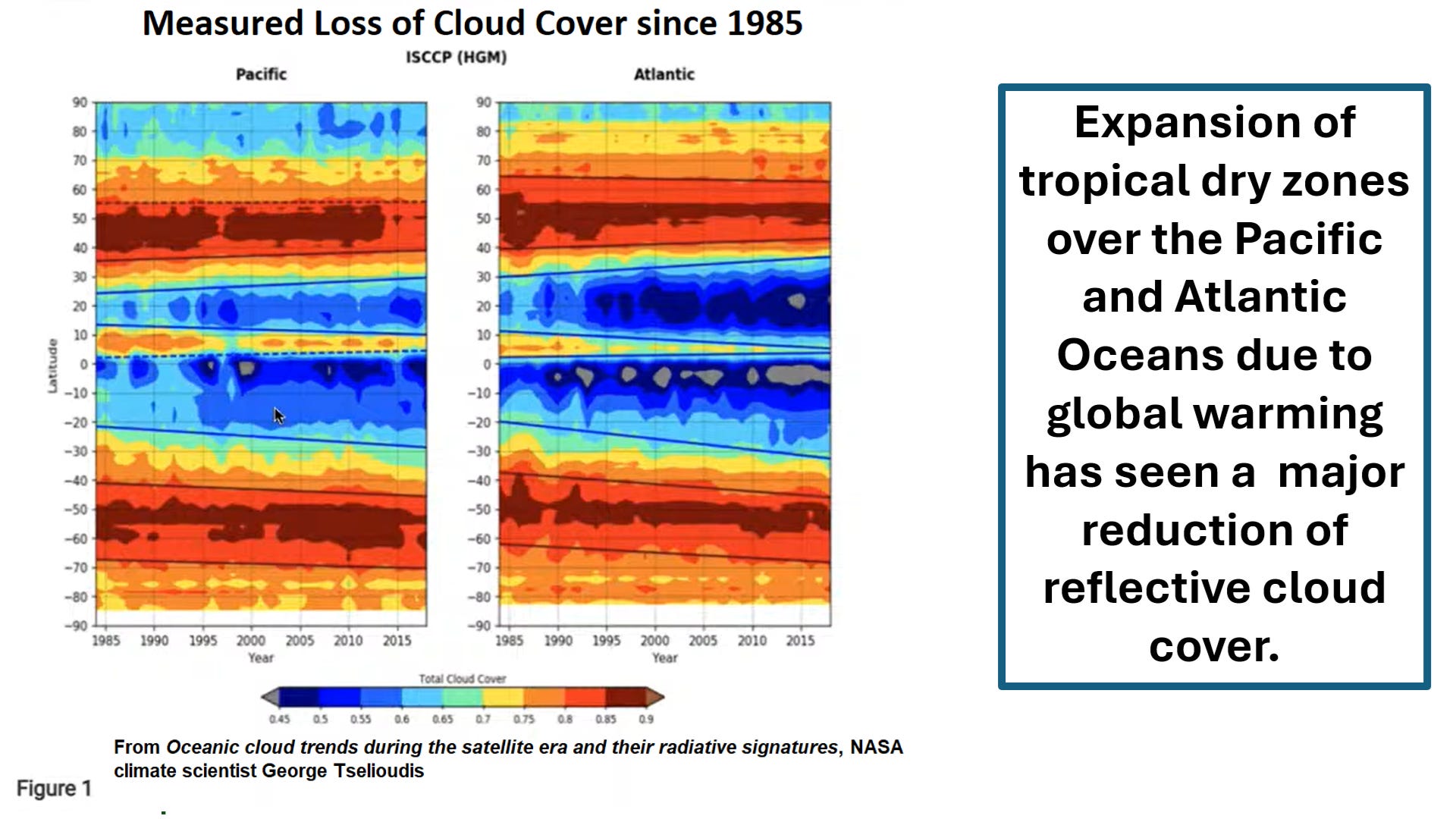
These storm belts – the familiar bands of low-pressure systems seen in satellite images – help organise vast areas of reflective cloud, including extensive low-level cloud decks in adjacent subtropical regions. When the storm zones contract, those low clouds thin or disappear, exposing dark ocean and land to more direct sunlight and increasing global absorption of solar energy.
Convection is the name for the weather process that causes warm air to rise and cool air to fall. Clouds in the bright storm-cloud zones are known as convective because they form in low pressure mid-latitude regions where warm, moist air is rising. As air ascends, pressure falls, the air expands and cools, and thick convective clouds form. These clouds are vertically deep, highly reflective, and associated with the familiar rotating storm systems seen on satellite images. Beyond producing weather, these low-pressure zones play a structural role in the climate system by lifting heat away from the surface and redistributing it through the atmosphere.
Adjacent to the storm belts, especially over the subtropical oceans, barometric pressure is typically high. In these high pressure regions, air that rose near the equator cools and sinks back toward the surface, warming as pressure increases, forming Hadley Cells, shown here with Ferrel and Polar Cells.
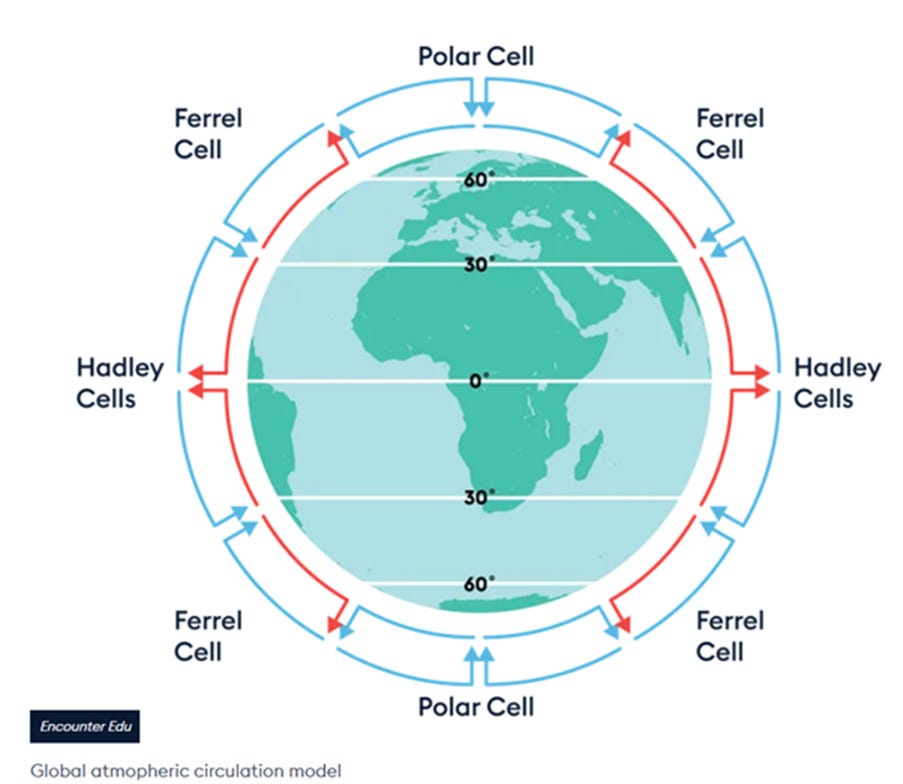
Cooler falling air creates a temperature inversion, leading to banks of warmer air sitting above cooler, moist surface air from upwelling deep currents. The inversion suppresses convection and traps moisture near the surface, favouring extensive decks of low-level stratocumulus clouds that are shallow but very bright and highly effective at reflecting sunlight. As heat enters the oceans, surface cooling is reduced, causing the cloud bank and its containing inversion layer to mix and dissolve.
The convective storm belts and the low-cloud regions function as a coupled system that now appears to be weakening in its reflectivity. Strong organised convection, drawing air upward in low-pressure zones, maintains the large-scale pressure gradients and circulation patterns that kept inversion layers intact in adjacent high-pressure regions. By efficiently exporting heat upward and poleward, the storm belts limit surface warming in subtropical oceans, protecting the stability and persistence of low cloud decks. In this way, convection near the equator and at the 60 degree Ferrel Cell uplift forms a planetary atmospheric pattern that organises and sustains widespread low-level cloud cover.
As the planet warms and sea-surface temperatures rise, these pressure relationships weaken. Storm belts contract and shift poleward, while surface warming in subtropical regions erodes inversion layers. Once inversions weaken, moist air breaks through into convection, replacing extensive low clouds with smaller, more localised convective clouds. Because convective clouds cover less area, the net effect is a sharp reduction in reflectivity. This reorganisation of clouds increases sunlight absorption and can accelerate warming in a way that is abrupt rather than gradual.
Tselioudis and his team concluded that this contraction of the world’s storm-cloud zones, and the associated loss of reflective low clouds, is the primary contributor to the 21st-century increase in the Earth’s absorption of sunlight.
This is a profound shift. Ice melt is a big factor in global warming, but the loss of clouds is far bigger. The renowned climate scientist Dr James Hansen has calculated that total albedo loss is made up of cloud loss (62%), aerosol loss (29%), and ice and snow loss (9%). Other factors such as growth of urban heat islands and other land use changes are together less than 1%. So the major Earth systems are changing in a way that makes Earth darker.
For risk managers, cloud loss is the climate equivalent of discovering that the fire sprinklers in your building have quietly had half their nozzles removed. Because cloud loss is by far the biggest factor, I have chosen to focus on it here to illustrate the scale of the albedo problem. Similar analysis is also possible for ice and snow and for atmospheric aerosols.
Ice and Snow – The Fading White Shield
In cool regions ice and snow are the most visible components of Earth’s albedo system. They act as a vast white shield, reflecting a large fraction of incoming sunlight back into space before it can warm the surface. Fresh snow can reflect more than 80% of sunlight; sea ice and glaciers typically reflect 50–70%, compared with less than 10% for open ocean. This contrast is one of the strongest energy controls in the climate system. Known as the cryosphere, the ice regions of our planet hold enough frozen water to raise sea level by almost eighty metres.
As the planet warms, this reflective ice shield is retreating rapidly. Arctic sea ice has declined by around 40% since satellite records began. Mountain glaciers are shrinking on every continent. Snow cover is arriving later and melting earlier. Each loss exposes darker land or ocean beneath, increasing solar absorption and accelerating warming. This is the ice–albedo feedback: warming melts ice, darker surfaces absorb more sunlight, which causes further warming and more melt.
What matters for risk is not just the long-term equilibrium, but the speed of this process. Ice sheets and sea ice respond nonlinearly. Once thinning reaches a critical point, melt rates can accelerate sharply due to mechanical breakup, warmer ocean water intrusion, and loss of buttressing ice shelves. These dynamics make ice loss a plausible near-term amplifier of warming, not just a slow background trend.
From a business perspective, ice loss matters well beyond polar regions. It contributes directly to sea level rise, threatens coastal infrastructure, ports and naval bases, and alters atmospheric and ocean circulation patterns, worsening storms, heatwaves and rainfall patterns across large regions, and potentially disrupting ocean currents.
Restoring lost reflectivity requires recognising ice as critical climate infrastructure. A cooler planet slows ice loss; a darker planet accelerates it. Albedo-focused strategies aim to stabilise this feedback and to protect and enhance snow and ice cover.
Aerosols – The Invisible Regulators of Cloud Brightness
Aerosols are tiny particles suspended in the atmosphere, and although they are invisible to the naked eye, they play an outsized role in Earth’s reflectivity. Many aerosols act as cloud condensation nuclei, helping water vapour form cloud droplets. The number, size and composition of these particles strongly influence how bright and long-lived clouds are.
Low marine clouds are particularly sensitive to aerosol availability. When aerosols are plentiful, clouds tend to have many small droplets, making them brighter and more reflective. When aerosols are scarce, droplets grow larger, clouds thin out, rain out more quickly, and reflect less sunlight. This sensitivity gives aerosols disproportionate leverage over planetary albedo, especially over dark ocean regions where cloud reflectivity has the greatest cooling effect.
Over recent decades, aerosol patterns have changed rapidly. Air quality regulations have reduced sulphate pollution from shipping fuel and the burning of coal. At the same time, natural aerosol sources linked to biology—such as sulphur compounds released by phytoplankton—are weakening as oceans warm and ecosystems are disrupted. The net effect appears to be a reduction in cloud brightness in key regions, contributing to the observed increase in solar absorption and global warming.
This creates a difficult but unavoidable trade-off. Reducing harmful air pollution is essential for human health, yet some aerosols have been providing an unintentional cooling service by maintaining cloud reflectivity. Removing them without replacing their albedo effect exposes latent warming that was previously masked. A later chapter will explore technologies that can provide aerosol cooling without the health risks.
From a governance perspective, aerosols illustrate why climate risk cannot be managed by emissions policy alone. The climate system responds to what reflects sunlight today, not just to long-term greenhouse gas trajectories. Managed sunlight reflection can replace accidental, poorly controlled aerosol effects with transparent, measured, and reversible interventions under international oversight. Reflectivity is a primary physical variable that must be managed deliberately for a stable climate. Ignoring this lever leaves one of the most powerful controls of planetary temperature to drift unmanaged.
Hansen’s 110 ppm: albedo in carbon language
Climate physicist Dr James Hansen[5] has tried to translate planetary darkening into a language most of the policy world understands: CO₂ equivalence. Other greenhouse gases like methane can be compared to the warming effect of CO₂ to create a single common measure known as global warming potential. Hansen has done something similar with albedo loss. Using Loeb’s CERES-Argo results and related data, he estimated that the drop in planetary reflectivity in the decade since 2015 is equivalent, in its heating effect, to suddenly increasing atmospheric CO₂ by roughly 110 parts per million (ppm), stating “this reduced albedo is equivalent to a sudden increase of atmospheric CO2 from 420 to 530 ppm.” [6]
For context, the total increase in CO₂ since the pre-industrial era is about 145 ppm. This suggests darkening over the last decade has delivered a fresh heating pulse three-quarters as big as all historical CO₂ emissions combined. CO₂ remains the main forcing driver of warming, but on the time scales relevant to business, loss of reflectivity is even more important. If you focus on emerging risks over the next 10–30 years – which every insurer, bank, military planner and farmer must do – you cannot afford to ignore the loss of albedo.
The blanket and the mirror
At this point it is useful to come back to the simple picture.
The climate system is governed by two main things:
How much heat escapes – the blanket (greenhouse gases, water vapour, long-wave infrared).
How much sunlight gets in– the mirror (albedo: clouds, ice, snow, aerosols, land and ocean reflectivity).
Most climate communication has focused on (1): we emit greenhouse gases, they trap more heat, the planet warms. This is right as far as it goes.
But Loeb, Tselioudis and Hansen are telling us that (2) is now moving just as fast – sometimes faster. The greenhouse effect acts on heat leaving the planet (long-wave infrared). Cutting emissions slows how quickly the blanket thickens; over time, that reduces the heating pressure. Albedo acts on sunlight arriving at the planet (short-wave). When we lose bright surfaces or clouds, more of that sunlight is absorbed as heat in the first place.
You can think of it like a house. The blanket lever is how thick your insulation is. The mirror lever is how much sunlight you let in through the windows, and whether you have blinds. If you remove the blinds in midsummer and paint the roof black, the house will overheat even if you never add more insulation. That is roughly what we have been doing to the planet.
The numbers are necessarily approximate, but they tell a consistent story. Each year’s global greenhouse gas emissions add roughly 0.04 W/m² of extra heating pressure from the greenhouse effect – that is, the blanket thickens by that amount. The current measured energy imbalance – the net heat actually being added to the planet – is around 0.8 to 1 W/m², depending on the period and dataset.
That extra heat includes both the direct greenhouse effect, known as climate forcing, and the feedbacks – mainly darkening (less reflective clouds and ice) plus other responses. On the multi-decadal horizon, Hansen’s 110 ppm equivalence tells us that albedo feedbacks are now comparable in strength to the direct greenhouse forcing from recent emissions, and appear to dominate the acceleration of warming.
For business, the important point is the direction of travel. The world is heating faster than predicted because models have underestimated the albedo effect of rapid darkening due mainly to loss of clouds. Any climate strategy that ignores that fact is a partial balance sheet.
A central message of this book is that cutting emissions is necessary in the long run but marginal in the short run. Carbon action is like treating the underlying disease – essential for the long term – but it does not, by itself, bring the fever down quickly.
The reason is timing. Carbon cuts today mainly affect how much extra greenhouse forcing we add in future. Planetary darkening is already here and already adding substantial heat right now. Even very ambitious emission cuts cannot make ice regrow, clouds re-thicken, or aerosols revert to their old patterns.
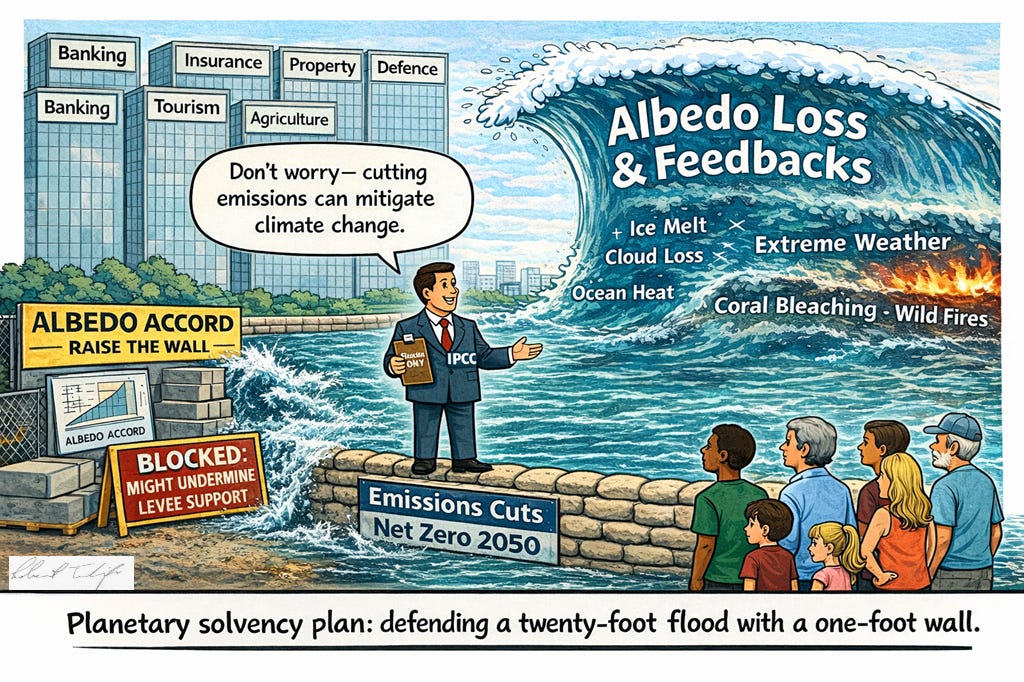
Using emission cuts to slow warming is like building a one foot levee to stop a twenty foot flood. Imagine a town by a river that is about to face a 20-foot flood. The authorities respond by building a one-foot levee. Technically, that levee does slow the flood down, perhaps by a few hours. But in the real world, the town still drowns.
Treating “carbon only” as the main climate lever is like betting everything on that one-foot levee. It makes a marginal difference to timing, but does not prevent the flood from overtopping the wall while people are still living there.
In the same way, removing excess greenhouse gases from the atmosphere will be essential to stabilise the climate. But on the timescales relevant to asset lives, debt, insurance and political stability, the short-term surge driven by albedo loss and other feedbacks, cutting emissions is largely irrelevant.
If the flood in this analogy is the surge of extra heat from planetary darkening and feedbacks, then albedo restoration is the only way to build a levee high enough, fast enough, to matter this century.
From physics to governance: the “albedo layer”
The ozone story provides a useful parallel. In the 1980s, scientists pointed out that certain chemicals were thinning the ozone layer, letting in more harmful UV radiation. Governments responded with the Montreal Protocol, a focused treaty to protect that layer.
Today, CERES, Loeb, Tselioudis and Hansen are effectively telling us that we are now damaging another protective layer – I call it the albedo layer – made up of ice, clouds, snow and aerosols. As the albedo layer thins and shrinks, more solar energy is entering the climate system, accelerating warming far beyond direct CO₂ forcing. Some of this feedback is incorporated into climate models, but it is emerging that the Earth is far more sensitive than models have predicted.
The ozone problem was caused mainly by a group of man-made gases – Chlorofluorocarbons – which could be phased out. The albedo problem at one level is more complex - caused by numerous interacting changes: greenhouse-driven warming, sea-ice loss, snow retreat, shifts in storm tracks, aerosol reductions, deforestation, ocean degradation and more.
And yet, restoring albedo could prove to be the simplest way to manage climate risk. For business and policy, it can sharpen the focus. Away from the impractical and unrealistic dreams of decarbonisation, and instead make cooling the Earth a higher priority than reforming the energy system.
To respond to all the processes now darkening the planet, we need a coordinated strategy to rebrighten it. That is what the Albedo Accord is about: treating sunlight reflection as critical infrastructure, with governance mechanisms capable of measuring the albedo layer accurately, understanding which human actions do most to change it, and deliberately increasing planetary reflectivity in safe, transparent ways to restore a stable energy balance.
Chapter 2 has told us that planetary darkening is real and measured. CERES satellites and ocean data show a 2% darkening, and resulting marked increase in the Earth’s heat uptake since the early 2000s. Albedo loss is doubling every decade, driven largely by reduced reflection of sunlight, fewer bright clouds, aerosol loss and less ice and snow. The cloud system itself is changing. New work by Tselioudis and colleagues finds that the contraction of the world’s storm-cloud zones is the primary contributor to the rise in absorbed sunlight so far this century – a structural shift in the planet’s “sunshade”.
The heating impact of recent darkening is comparable to a huge jump in CO₂. Hansen’s 110 ppm equivalence shows that, in the last decade, albedo loss has delivered a warming shove three-quarters as large as all industrial CO₂ emissions – compressed into a short time window.
For executives and policymakers, the implication is straightforward:
If you build climate strategy around emissions alone, you are looking at only half the balance sheet. The other half – how bright or dark the Earth is – is now moving fast enough to make or break the insurability, solvency and stability of the systems you rely on.
The rest of this book will argue that:
We need to measure and manage albedo with the same seriousness we apply to greenhouse gases.
We need to design institutions – an Albedo Accord – that can govern sunlight reflection as a public good.
Doing so is not a radical fantasy, but a pragmatic extension of what we have already done once for the ozone layer.
The planet is dimming. The storm-cloud belts are retreating. The mirror is losing its shine. If we want to keep the climate within bounds where business, food systems and societies can function, we have to restore that shine.
https://ceres.larc.nasa.gov/
https://argo.ucsd.edu/
[4] https://agupubs.onlinelibrary.wiley.com/doi/10.1029/2025GL114882
[5] https://csas.earth.columbia.edu/about/people/james-e-hansen
[6] https://www.columbia.edu/~jeh1/mailings/2024/AnnualT2023.2024.01.12.pdf