
Sunlight Reflection - Introduction
The Planet Is Going Dark

Introduction – The Planet Is Going Dark
We all know the simple picture of climate change. Fossil fuels provide most of our energy, greenhouse gases are building up, and as a result the planet is warming. That picture is true. But the conventional answer from the climate science community and its allies – that we should mainly stop using fossil fuels – is not adequate or tenable on the time scales that matter to business and governments.
This book takes a realist pro-business line on climate. It accepts the science and asks a different question: given the risks we now face, what is the most effective way to cool the Earth and stabilise the systems we depend on? My aim is to convince business and policy leaders that planetary darkening is a core risk to solvency and stability, and that an Albedo Accord can provide a practical, governed path to cool the climate and protect their balance sheets.
Albedo is the scientific term for the brightness or reflectivity of a surface. Clouds, ice, snow, sand, aerosols and other bright surfaces have high albedo, while oceans, forests, roads and other dark surfaces have low albedo.
Overall, the average albedo of the whole Earth – the proportion of sunlight reflected back to space – has fallen from about 29.3 percent in 2003 to below 28.7 percent in 2026 as measured by NASA. In 2003, the Earth reflected almost 100 watts from each square metre on average. Albedo reflectivity has now fallen below 98 watts per square metre. This means the Earth is now more than two percent darker than two decades ago. And the darkening is speeding up. The rate of albedo loss has doubled every decade this century.
The resulting absorption of heat due to lower albedo is causing more warming than new emissions. This means emission reduction by itself cannot possibly be enough to stabilise the climate, even together with new technologies to remove carbon dioxide and methane from the atmosphere. Sunlight reflection technologies are needed to provide certainty for business planning and investment, to rebrighten the Earth and cool the climate.
Businesses should be thoroughly alarmed about the bottom-line risks from global warming. “Alarm” is often used to dismiss climate extremists, but rising heat is now attacking the core functions that make modern commerce possible: insurance, credit, weather, infrastructure, stability. The lack of serious attention to these climate risks is dangerous.
There should be no sympathy for arguments that deny basic physics or that wave away risk as someone else’s problem. But equally, the prevailing idea that we could fix the climate by manipulating carbon while doing nothing about the loss of albedo is also unscientific.
The blanket and the mirror
The main features of climate science are settled. The greenhouse effect – the direct trapping of heat by carbon dioxide and other gases such as methane – is simple science known since the nineteenth century. 99.5% of the atmosphere is made up of nitrogen, oxygen and argon. These gases do not trap heat. It is the remaining half a percent, mainly water vapour, carbon dioxide, methane and nitrous oxide, that is responsible for keeping our planet warm. These greenhouse gases create a warming blanket around the Earth. They are largely transparent to incoming sunlight but slow the amount of heat leaving the planet, holding in warmth like the glass in a greenhouse. If there were no greenhouse gases, as on Mars, our planet would be a frozen “Snowball Earth”. With far more greenhouse gas, as on Venus, the oceans would boil away. Earth is the Goldilocks planet, just right for life. We need to keep it that way.
Adding more greenhouse gases makes this blanket thicker, warming the planet. Scientists can measure this direct heating very precisely. The GHG total including equivalents is now almost double the pre-industrial CO2 level, at 539 ppm compared to 278 ppm.[1] On average, each year’s greenhouse gas (GHG) emissions – roughly forty billion tonnes of CO₂ plus another ten billion tonnes of CO2 equivalence from other GHGs– directly add a tiny amount of extra heat to every square metre of the Earth’s surface due to the greenhouse effect. Over the whole planet, that tiny amount, averaging about 0.04 watts per meter, adds up to a lot of extra energy.
What is less well known is that the direct heating from the growing greenhouse blanket, known as climate forcing, is now surpassed by larger indirect heating processes, known as climate feedbacks. Feedbacks are natural processes such as the loss of clouds and ice and aerosols that are caused by warming and that amplify the direct climate forcing. The resulting darkening of the Earth is like an increasingly dusty mirror. A darker planet means that more sunlight is absorbed as heat instead of bouncing back to space. All that extra heat is destabilising the climate system on which our economic system depends.
In simple terms, the climate is shaped not just by the blanket of greenhouse gases but also by the mirror of planetary reflectivity. For the last decades, the darkening of the mirror has been giving the climate a much harder shove than most people realise.
Satellite and ocean measurements now show that the planet is taking up heat much faster than it was twenty years ago. A 2021 study led by NASA scientist Norman Loeb found that Earth’s heating rate roughly doubled between 2005 and 2019.[2] Most of this extra energy is not from more greenhouse trapping, but from darkening – the planet reflecting less sunlight, mainly because of the decline of low clouds and sea ice. The overall warming calculation is known as the Earth Energy Imbalance, the excess of incoming light over outgoing heat.
Climate physicist James Hansen has translated the recent darkening of the Earth into “CO₂-equivalent” terms. Using NASA data, he estimated in 2024 that the drop in reflectivity since 2015 was equivalent to suddenly increasing atmospheric CO₂ from 420 to about 530 parts per million – a jump of 110 ppm. For comparison, the entire rise in CO₂ since the Industrial Revolution is about 145 ppm. In other words, albedo loss over one decade delivered a fresh warming shove that was three-quarters as large as all historical CO₂ emissions. These climate feedbacks are a big deal. And they are growing. And nothing we do about carbon can slow them in the short term.
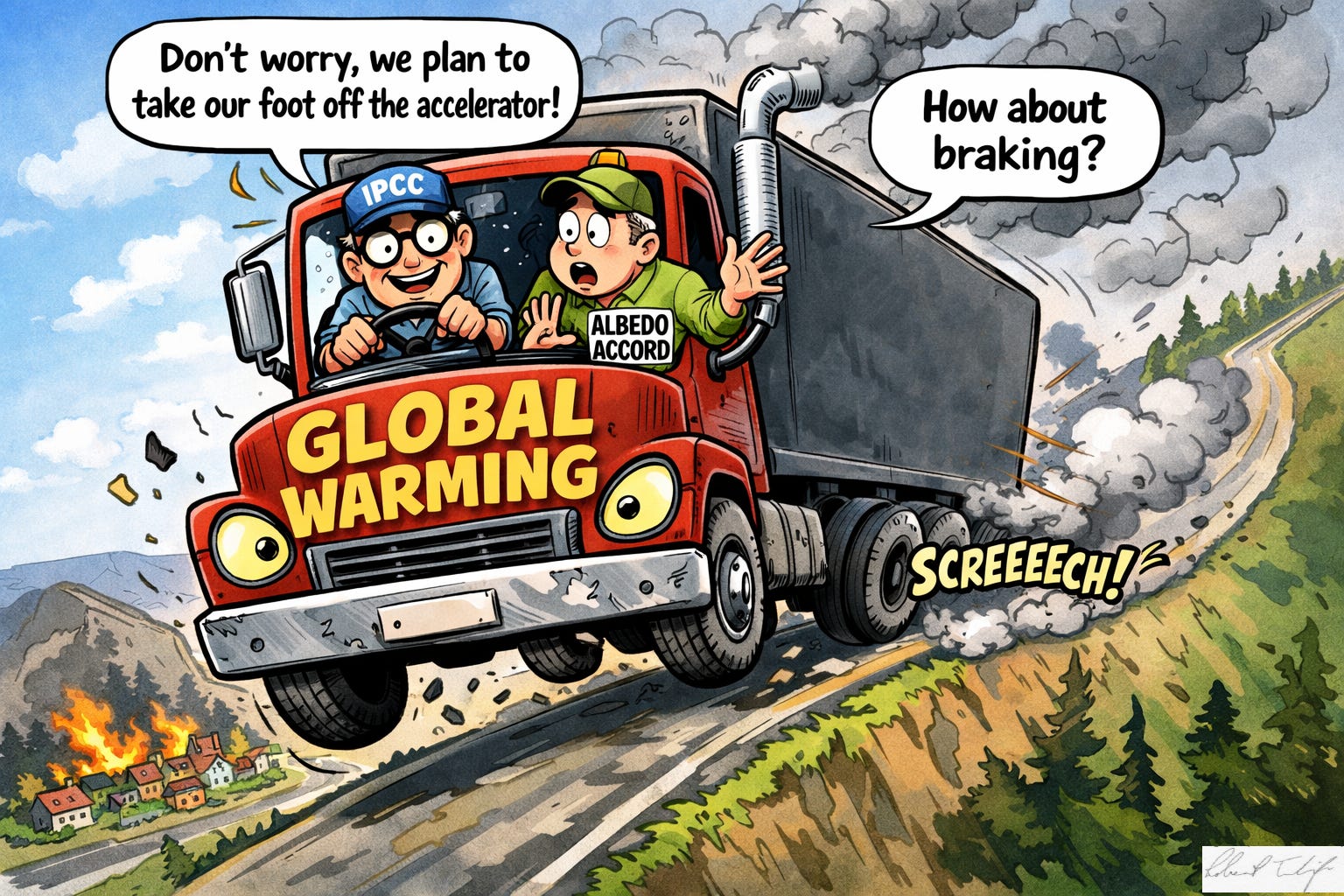
Climate feedbacks mean global warming is now dominated by the decline in planetary brightness, not just by the steady rise in CO₂. A climate strategy that only pulls the carbon lever is like trying to stop a runaway truck by easing off the accelerator while the road has just turned sharply downhill. Unfortunately, that failed approach is the one endorsed by the climate establishment in the Intergovernmental Panel on Climate Change. This book argues that a new approach is possible.
The planet’s fever has spiked
The bottom line is that Planet Earth is in fever – already around 1.5°C above pre-industrial average and trending towards 3°C or more this century if nothing changes. The dangers are equivalent to high fever for a person. Our current climate policies are like a patient with meningitis who does nothing about it, or perhaps takes a few aspirin in the hope it will go away. The fever is obvious, the test results are back, but instead of admitting the problem and going straight to intensive care, the patient pops some pills, promises to live better next year and avoids mentioning the word “infection”.
That is roughly where the world sits with climate: a dangerous energy imbalance and a darkening albedo layer are already driving a planetary fever, yet policy effort goes into vague long-term promises about future emissions, not into direct cooling. Carbon action is essential for climate stability, and often has significant local environmental and economic benefits. But when meningitis fever is already in the brain, prevention alone is not enough. The first duty is to stabilise the patient – to bring the temperature down. That is what governed sunlight reflection is for.
When warming becomes uninsurable
Insurance, banking, agriculture, shipping, energy, tourism, defence and other industries already face major commercial damage from climate change. This risk cannot be meaningfully reduced by emissions cuts alone over the next few decades.
Insurance losses related to climate – floods, storms and wildfires – have climbed to well over US$100 billion a year in insured losses and perhaps US$300 billion in total economic damage, repeatedly blowing past historical expectations and existing risk models. A major series of annual reports from the UK Institute and Faculty of Actuaries has introduced the concept of “planetary solvency” to assess climate risk. It warns that on our current trajectory we face a growing danger of planetary insolvency – a breakdown of the natural foundations that support the global economy. And an insolvent climate means insolvent businesses.
Ernest Hemingway famously wrote that you go bankrupt in two ways: gradually, then suddenly. The climate is now gradually going insolvent. Averting “the sudden way” will require a deliberate change of course – a strategic pivot from focusing solely on carbon to also tackling planetary brightness - albedo. We are not yet in the situation of requiring appointment of a liquidator. What is needed is a recognition of the emerging business risks and the need for a strategy to manage them. The Albedo Accord aims to be central to that strategy, through a well governed and accountable coordinated response.
Commercial symptoms of this emerging planetary insolvency are already visible. Banks and asset managers are re-pricing property and debt as physical risks accelerate. Farmers are juggling volatile yields, heatwaves and shifting rainfall. Energy systems designed for a milder climate are strained by record heat and demand spikes. Tourist destinations are damaged by bleaching reefs, smoke-filled summers and winters without snow. Defence planners now treat climate change as a threat multiplier that can destabilise entire regions and drive waves of climate refugees. The Iran war reveals the fragility of global supply chains.
These business challenges are part of a systemic shift. As the planet darkens and absorbs more solar energy, the climate system is heating faster than many models assumed. We are now crossing the 1.5°C threshold that the Paris Agreement assumed would take at least another decade to breach. The result is a world where extreme events become more frequent, more damaging and harder to predict, undermining the planning foundations on which risk management and long-term investment rely. It is now common to hear that “hundred-year events” seem to happen all the time.
From the perspective of a boardroom or a finance ministry, the key question is whether the physical climate will remain stable enough to keep property insurable and assets investable. On that question, the physics of albedo are now front and centre. Companies need to invest in managing this problem.
A Brighter Planet is a Public Good
Economists use the term public good for things from which everyone benefits and no one can be excluded. Examples include lighthouses, clean air and the stratospheric ozone layer. A brighter Earth delivered through an Albedo Accord is a public good because it reduces the heat that is driving dangerous warming and climate risk.
Planetary darkening is the big missing piece in the climate puzzle. Most people – including many business leaders – are unaware of this key climate risk. We are not only loading the atmosphere with greenhouse gases. We are also accidentally dismantling the reflective surfaces and cloud shields that used to keep the Earth cooler. The albedo layer – made up of clouds, ice, snow and aerosols – is as critical for a healthy planet as the ozone layer. Yet unlike the ozone layer, our planetary albedo layer has no dedicated governance regime. And what is worse, there is a large and well-funded campaign by misguided environmentalists to prevent albedo action.
When the planet reflects more sunlight, everyone shares the benefits: fewer deadly heatwaves, less brutal storms, more predictable seasons, lower heat pressure on crops, infrastructure and biodiversity. No country or company gets a cooler climate just for itself. Conversely, when the planet darkens, all share the harm, whether they contributed to the change or not.
Public goods always face the problem of free-riding: everyone benefits, but no single actor has enough incentive to pay for them alone. That is part of why managing climate through carbon policy alone has proved so difficult. The costs are concentrated and visible, while the benefits are diffuse and long-term. By contrast, rebrightening the planet could be done extremely cheaply. The cost of technology to cool the Earth was estimated by the UK Royal Society at one thousandth of the cost of the equivalent cooling from decarbonisation.[3] With this extreme cost differential, and the immense benefits from reduced extreme weather, leading economists have argued that sunlight reflection is “essentially costless” at the global scale.[4]
The opportunity this creates is simple. The shared interest in the stable climate that can be delivered by sunlight reflection is exceptionally broad and strong. Insurers, banks, agribusiness, shipping lines, logistics firms, energy utilities, tourism operators and defence establishments all need a climate that stays within predictable bounds. None of them can secure that outcome by themselves. All will be damaged if we fail. All benefit from a policy focus on the public good of cooler temperatures delivered through a governed framework for sunlight reflection. These affected businesses need to work together to convince governments and the broader public that restoring planetary albedo is essential business infrastructure, urgently needed to reduce the scale of loss and damage in the climate pipeline.
Why an Albedo Accord?
To reduce how much sunlight the Earth absorbs, we have to recognise planetary reflectivity as a central variable in climate risk, and we have to manage it. The ice sheets, snow fields, bright clouds and aerosols that cool the planet are declining fast. If we ignore those changes, we let the most powerful input to the climate system – incoming solar energy – drift out of control. That scenario should be unacceptable on security and stability grounds, in addition to its economic, social and ecological damage.
In this book I argue that restoring and managing Earth’s albedo is now essential, not optional. The debate should no longer be about whether we will need to rebrighten the planet, but about how, how much, when, under what rules, by whom and with what safeguards.
I call this governance framework an Albedo Accord. Just as the Montreal Protocol built a dedicated regime to protect the ozone layer, an Albedo Accord would build a dedicated regime to protect and restore the albedo layer. A Montreal-style agreement can manage sunlight reflection as a public good.
Later chapters will set out what such an Accord could look like, how it might interact with existing institutions and why conservative, pro-business leadership – like that provided by Margaret Thatcher and Ronald Reagan for the Montreal Protocol – will be essential for success today.
Who this book is for
This book is written for people whose decisions shape the real economy:
business leaders and executives
risk managers and insurers
investors and regulators
policymakers and advisers in finance, security, energy and agriculture
The aim is to give you a clear explanation of planetary darkening and why it matters. A simple picture of the climate system and an honest assessment of options for rebrightening the Earth show the urgent need for a concrete governance proposal – the Albedo Accord – that industries and governments can realistically champion.
As long as the Earth continues to grow darker and absorb more solar energy, no major industry can count on a stable climate. Emissions cuts alone cannot guarantee that the world remains insurable and investable on the time scales that matter.
The planet is going dark. Our task now is to decide, together, how to rebrighten it – carefully, transparently and fairly – before the risks outrun our capacity to adapt.
That is the story this book will tell.
Some Principles
This book is written in a spirit that values clear sight, plain speech and disciplined courage. Climate politics is full of ritualised optimism, among both decarbonists and deniers. Sunlight Reflection finds grounds for optimism in assessment of the hard facts required to sustain a liveable Earth, seeking to develop a climate strategy that is acceptable and realistic for our current economic system, in order to create a feasible path to a cooler planet.
Honesty comes first. A key principle is a rigorous insistence on objective reality and scientific integrity. The renowned physicist Richard Feynman famously said during the investigation into the 1986 Challenger space shuttle disaster, “for a successful technology, reality must take precedence over public relations, for nature cannot be fooled”.[5] If a claim is convenient but false, it is worse than useless because it steals time and resources. This book insists on facing inconvenient truths: that warming is driven by more than emissions, that feedbacks have their own momentum, that delay has already locked in risk. It also insists on honest accounting to assess what tools exist, what they can and cannot do, what trade-offs they entail, and what governance would be required to use them responsibly. Everything is improved when the rules are explicit, the assumptions are stated and the incentives are named.
Climate debate is a field of power, careers, funding streams, brand protection, moral signalling, geopolitical interest and conflicting agendas. Sunlight Reflection asks who benefits from which policy, who loses if the frame changes, which institutions are invested in a single-track story, and which constituencies might support stabilisation if we speak in the language of risk and responsibility. The point is competence. We need realism, based on contestable evidence and logic, to build a durable coalition for climate stability.
Forthrightness is a discipline. The book aims to get to the heart of the matter and stay there. That means saying plainly what many people only imply: that the dominant climate story is confused and inadequate. Cutting emissions is a means. Cooling a dangerously overheating planet is the end. When means are treated as ends, policy becomes about moral identity rather than practical results. The book’s voice seeks to be direct and no-nonsense because the situation calls for a refusal to flatter comforting illusions, choosing clarity and rigor over emotion and popular assumptions.
When topics become sacred, they become fragile, and fragility is the enemy of truth. Humour is not disrespect. It is a way to puncture pretence, defuse tribal hostility and keep perspective when the rhetoric turns apocalyptic. Sunlight Reflection treats the climate crisis seriously, while also exposing the absurdity of many superficial opinions through better arguments. Courteous and respectful dialogue is essential to compare differing views.
People are complicated, institutions are slow and progress is messy. Designing governance for an Albedo Accord must be resilient against deception, hype, perverse incentives and soft choices. Placing ideology before evidence guarantees failure. A workable climate stabilisation strategy has to combine scientific and economic realism.
Put together, this temperament shapes the central themes of the book. Tell the truth about the climate problem, especially feedbacks and albedo loss. Understand the political dynamics that make some tools taboo. Reject deception, wishful thinking and moral theatre. Argue for stabilisation with adult governance, not utopian slogans. Build coalitions based on shared risk, including industries and nations with much to lose from chaos. Keep a clear head, a clean logic and a sense of humour. Recognise that effective policy is incremental and evolutionary, not divisive and revolutionary.
A useful way to read this book is to keep returning to a handful of self-check questions: Are we being completely honest, especially where the truth is inconvenient? Have we worked out what is really driving the debate beneath the surface? Are we getting to the point or hiding behind abstractions? Are we being fooled by prestige, tribal loyalty or fear of controversy? Can we accept that both sides have blind spots?
If you can hold that posture steady, the argument of Sunlight Reflection becomes simple: stop confusing political comfort with physical reality, stop mistaking moral identity for climate policy, and start building a clear, fair, safe, fast, open and well governed pathway to a stable climate and a repaired world.
[1] https://gml.noaa.gov/aggi/
[2] https://agupubs.onlinelibrary.wiley.com/doi/10.1029/2021GL093047
[3] https://royalsociety.org/-/media/policy/publications/2009/8693.pdf Table 3.6
[4] https://journals.sagepub.com/doi/10.1177/2053019614554304
[5] https://www.edwardtufte.com/notebook/richard-feynmans-nature-cannot-be-fooled/
Nice "prologue" of Sunlight Reflection, Robert. Will dive into methods ww can do now on the surface as a "must do" as sai and mcb are perfected. Every watt counts and is cumulative.