
Chapter Ten: Cooling First Makes Carbon Action Easier
Draft for Discussion

The central problem in climate policy is no longer a lack of good intentions. It is sequencing.
We have built an entire global architecture around the idea that cutting emissions is the first, best and sufficient response to dangerous warming. That architecture has achieved real progress in places, especially where clean energy became cheap and politically popular. Yet it has also collided with three stubborn constraints that earlier chapters have already brought into focus.
First, the physical constraint: Earth’s near-term temperature trajectory is now heavily influenced by reflectivity and fast feedbacks, not only by marginal changes in greenhouse gas flows. Second, the political constraint: societies are not mobilising at the speed implied by the most ambitious pathways, and when citizens are told that only one path is morally acceptable, the predictable result is backlash, delay and paralysis. Third, the governance constraint: the institutions that coordinate carbon policy are not designed for emergency stabilisation under uncertainty.
This chapter is the bridge chapter. It connects the diagnosis of climate politics and institutional gridlock (Chapter Four) to the practical toolbox and governance issues of sunlight reflection (Chapter Seven). Its claim is simple, businesslike and testable:
Cooling first makes carbon action easier, cheaper and more durable.
Cooling is the emergency brake. Decarbonisation and carbon removal are the engine rebuild. The most realistic route to long-term climate stability is to do both, but in the right order, with clear rules that keep the world committed to finishing the job.
Stabilise the patient, then treat the cause
Medicine provides the right instinct. When a patient presents with a dangerous fever, a competent clinician stabilises the temperature first. Then they treat the underlying cause. The doctor who insists on treating only the cause while refusing to lower the fever is not being “more principled”. They are taking an avoidable risk with a fragile system.
Climate policy has drifted into exactly that avoidable risk. The dominant mitigation narrative often implies that decarbonisation plus some carbon removal is sufficient to prevent dangerous climate change, without any need to actively manage reflectivity. In principle, in a world of perfect coordination, rapid compliance and benign Earth system responses, you might get away with that. In practice, it is a scientifically incomplete approach to risk management because it discounts time constants, compliance risk and tipping dynamics.
Cooling first is not a denial of causality. It is respect for it. Temperature is the acute symptom that drives cascading failure. Greenhouse gases are the deep cause. Albedo is a powerful near-term control lever for the symptom. Carbon action is the durable cure for the cause. Sequencing means you stabilise now so you can cure for good.
Three ways cooling makes carbon action easier
Cooling first is not a slogan. It is a strategy that opens three channels of feasibility: fiscal capacity, political capacity and biophysical durability. To engage effectively with business and government leaders, these are the three channels to make concrete.
1) Fiscal slack: stabilise risk, lower the cost of capital
Decarbonisation and carbon removal are capital programs. They require long-lived assets, large up-front investment and stable policy over decades. That is hard enough in calm conditions. It becomes brutal in a world of repeated climate shocks.
As disasters rise, budgets are cannibalised by emergency response, reconstruction, bailouts and political firefighting. Private capital responds by demanding higher returns for long-lived infrastructure. Insurance costs rise, coverage retreats and the cost of capital climbs. In that environment, the clean build that leaders claim to support becomes the first thing delayed, watered down or used as a scapegoat.
Cooling first is a macroeconomic stabiliser. If the climate stops deteriorating at the current pace, risk premia soften. If risk premia soften, the financing environment for decarbonisation improves.
The logic is simple:
less volatility means fewer fiscal shocks
fewer shocks means more predictable planning
more predictability means lower risk premia
lower risk premia means faster clean investment
This is why a cooling-first strategy can speak directly to treasuries, finance ministries, central banks and the insurance sector. It is not only about protecting ecosystems. It is about protecting the conditions under which investment is possible.
Vignette: The insurer’s balance sheet
A CFO at a major insurer does not have the luxury of ideology. They have to price risk, hold capital and stay solvent. In a climate of rising extremes, they do three things: raise premiums, reduce exposure and tighten terms. That feeds directly into household stress, business costs and political anger. Governments then face pressure to subsidise premiums or act as insurer of last resort. The fiscal burden grows. Long-term infrastructure programs become harder to fund and harder to defend.
Cooling first changes that. If peak risks flatten, pricing stabilises. If pricing stabilises, capital can be allocated to productive investment rather than defensive retreat. That is how we can turn climate policy from a culture war into a financeable program.
2) Political bandwidth: reduce panic, reduce backlash
Climate policy fails when it demands sacrifices that feel pointless.
If citizens are told to accept higher costs, disruptions and constraints but still experience worsening heat, fires and floods, many will not conclude “we must try harder”. They will conclude “this is not working” or “this is a racket”. Cynicism and conspiracism thrive in the gap between promised outcomes and lived experience.
This is not just messaging. It is legitimacy.
Cooling first changes what people can see. If the climate stops deteriorating as fast, politics changes. The wedge issue loses some of its bite. The incentive to punish incumbents for climate pain declines. The appetite for longer-term structural reform rises. Decarbonisation becomes a policy that can survive elections, recessions and wars.
That is the core political function of cooling first: it buys legitimacy. It lowers the temperature of the debate as well as the temperature of the planet.
Vignette: The mayor after the flood
A mayor stands in front of cameras after a flood and says the usual lines about resilience and rebuilding. Behind the scenes, the city’s budget is wrecked, the bond rating is under pressure and key employers are reconsidering whether to expand locally. Now imagine the same city trying to sell voters on a ten-year decarbonisation program involving construction disruption, higher rates and unpopular planning reform.
In a crisis spiral, long-term programs lose. Even good leaders become short-term managers. Cooling first is a way to stop governing from turning into permanent triage.
3) Biophysical durability: protect the sinks you will depend on
Carbon removal only works at scale if sinks behave. Forests, soils and oceans are not inert warehouses. They are living systems with thresholds. As temperature rises and extremes intensify, sinks become unstable. Fire turns forests from sinks into sources. Heat and drought weaken vegetation. Warming oceans absorb less CO₂ and become chemically less forgiving. Permafrost and methane systems introduce tail risks that do not respect policy timetables.
A carbon strategy that relies heavily on nature-based removal while allowing temperatures to spike is like building your house on wet sand. Cooling first aims to keep sinks within a regime where restoration is more likely to persist and where measurement, reporting and verification remains credible.
This is the quiet technical link between cooling and carbon: cooling protects the very systems that make carbon removal practical.
Vignette: The carbon project that burns
A company funds a large-scale reforestation project and books future removals. It looks clean on paper. Then a heatwave and wildfire season arrives, the forest burns and the ledger becomes a political scandal. The public concludes that carbon removal is greenwash. Regulators overreact. Investment retreats. That is how confidence collapses.
Cooling first is not a guarantee against fire but it is a way to reduce the odds that carbon strategies fail in the most visible and demoralising way.
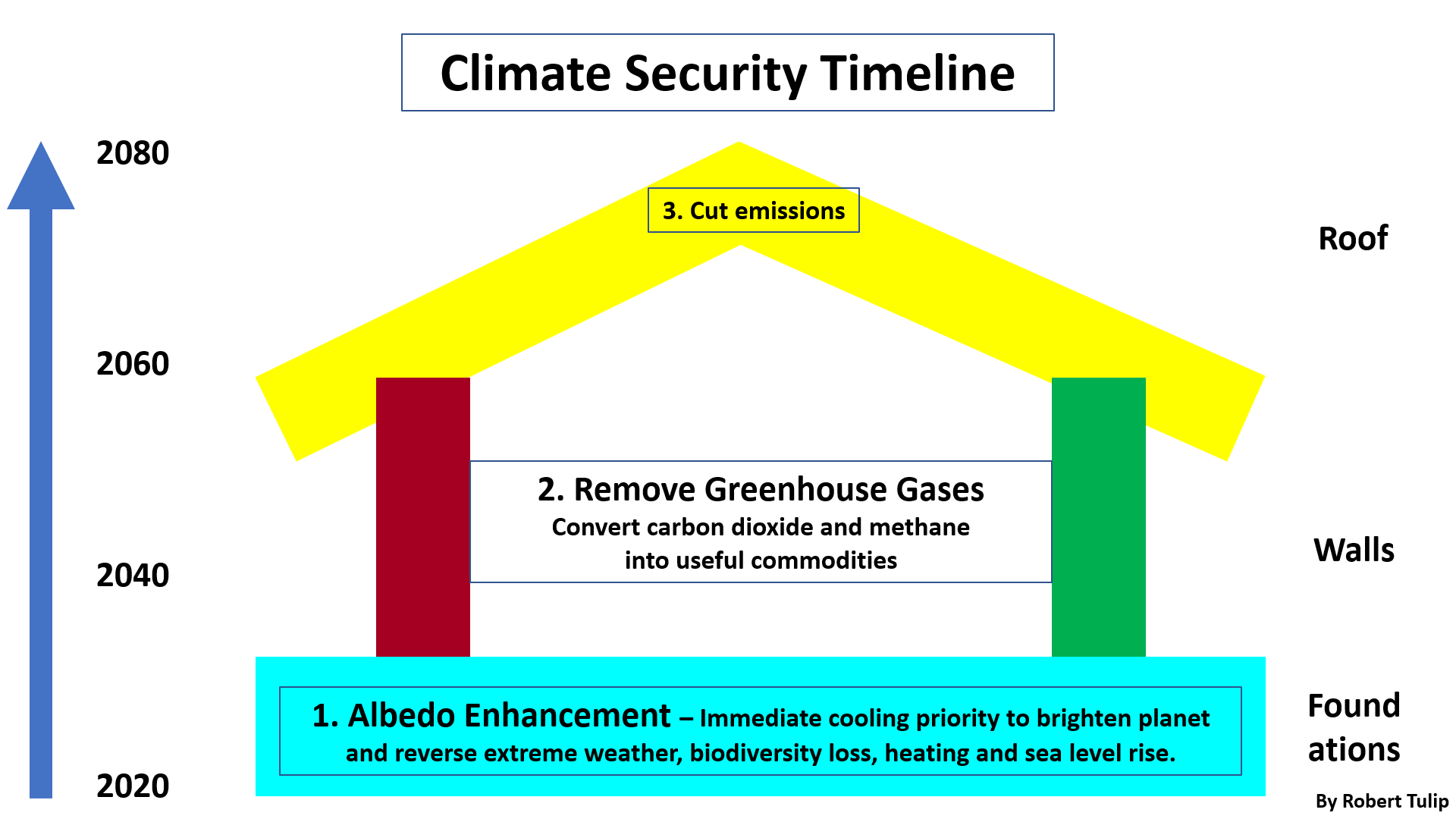
The sequencing model: foundations, walls and roof
This book is not arguing for a single, linear plan where one action waits politely for another. We must build in parallel. But sequencing matters because some tasks depend on stable conditions.
The house model captures it:
Foundations (cooling): restore reflectivity to stabilise temperature risk and volatility
Walls (carbon removal): scale removals to restore a safe carbon budget
Roof (decarbonisation): rebuild energy and industry so the problem does not recur
We build all three at once but we must pour the slab first. A stable platform makes the rest buildable.
This framing also answers a recurring misunderstanding. Cooling first is not cooling only. Cooling first is a stabilisation program coupled to a structural transition.
Why mitigation-first became polarising
Chapter Four described how climate politics drifted from practical cooperation into moral theatre, with predictable results: tribes formed, language hardened and the space for realism shrank. It is worth stating plainly why mitigation-first became such a reliable polariser.
It asked societies to do something very hard at massive scale on a tight timetable while offering a payoff that is difficult to see in everyday life. It also embedded a form of political fragility: if you frame decarbonisation as the only legitimate response and the climate continues to worsen, the movement looks like it is failing even when it is making progress.
There is a second issue that business understands instinctively. Most emissions come from systems with huge sunk capital: grids, steel, cement, shipping, aviation, industrial heat and agriculture. Markets are excellent at scaling what is profitable. They are less excellent at retiring trillions of dollars of assets on a timetable that voters did not choose.
Cooling first acknowledges this reality. It does not romanticise it, excuse it or surrender to it. It simply refuses to bet civilisation on an idealised timetable.
Jevons and the growth trap, used carefully
Jevons’ paradox is often used as a cudgel, as if it proves that renewables are pointless. That is not the argument here. The argument is more practical.
In a growing global economy, cheaper energy services can drive higher total energy use. New supply can add rather than substitute. This is one reason why fossil decline has been slower than the rhetoric in many jurisdictions and why global emissions can keep rising even as clean energy expands.
The policy lesson is not that clean energy does nothing. The lesson is that substitution is not automatic. Outcomes depend on system behaviour: regulation, retirement schedules, demand growth, geopolitics and the pace at which firms can change physical plant.
Cooling first reduces the danger of betting everything on a single pathway that assumes ideal substitution at ideal speed.
This is also where the chapter’s title earns its keep. If cooling stabilises the near-term risk environment, the politics of substitution becomes easier. People can accept the disruptions of transition when they are not simultaneously living through accelerating chaos.
Cooling first with guardrails
Every serious reader will ask the same question: if we cool first, what stops society from declaring victory and walking away from carbon action?
This objection is legitimate. It is also solvable.
Cooling first must be governed as a stabilisation program with explicit guardrails, not as an alternative ideology. Guardrails are what make the strategy credible to sceptics and supporters alike.
Here are the guardrails that belong in your chapter because they translate the concept into an investable, governable program.
Dual mandate: reflectivity intervention is authorised only as part of a coupled program that includes decarbonisation and carbon removal targets. Cooling is not a substitute. It is a bridge.
Transparent objectives: the goal is to reduce peak temperature risk and volatility, not to engineer a preferred climate or chase political advantage.
Monitoring and feedback control: deploy only with measurement, thresholds and adaptive adjustment. Treat the intervention as a control system, not a crusade.
Diversification and resilience: avoid single-point dependence. Use a portfolio, reduce overreliance on any one method and build the capacity to taper, pause or shift.
Equity and legitimacy: build procedures that include those most affected, with visible mechanisms for grievance, compensation and adjustment.
Hard review cycles: embed periodic renewal requirements. If carbon milestones are met and risk declines, stabilisation must be demonstrably taperable.
These guardrails also connect back to the governance argument in Chapter Seven: the central issue is not a lack of technical options. It is legitimacy, accountability and disciplined restraint.
Risk-risk, not purity vs heresy
This book’s core move is to treat climate policy as risk management under uncertainty, not as moral theatre. That means the relevant question is not “is cooling risky?” It is “compared to what?”
This risk-risk framing should be explicit in Chapter Eight because it is how you keep the argument grounded and keep critics from pretending that inaction is the safe option.
Moral hazard and mitigation deterrence
Yes, cooling can reduce perceived urgency. That is why you tie stabilisation to carbon milestones and keep the objectives public and measurable. But there is a second moral hazard that receives less attention: the hazard of insisting that mitigation alone is sufficient when it is politically unrealistic and physically exposed to tipping risks. That posture can create disillusionment and backlash that delays everything.
The solution is not denial. The solution is governance design.
Termination shock
Termination shock is a real risk if a large, sustained cooling intervention is abruptly stopped while greenhouse gas levels remain high. That is precisely why cooling first is paired with carbon action and designed for tapering and redundancy. Termination shock is an argument for responsible governance, not an argument for refusing stabilisation.
Many modern systems have risks that are managed because the alternative is worse. This is one of them.
Regional impacts and unintended consequences
No climate pathway is consequence-free. Warming itself imposes uneven harms, already distributed unfairly. A stabilisation program may also have uneven effects. The task is to build a regime where those effects are visible, measurable and adjustable, with genuine mechanisms for correction.
This is where your complex adaptive systems framing belongs. You are not promising perfect prediction. You are proposing monitored nudges with feedback control, learning and adjustment.
Technocratic overreach
The fear here is understandable. The answer is that climate destabilisation is already an imposition by the past on the future without consent. The correct response is not to romanticise inaction. It is to build institutions that are legitimate, transparent and accountable.
Cooling first is not rule by engineers. It is rule by rules.
A practical roadmap: what success looks like in 5, 10 and 20 years
A chapter like this should end with a delivery narrative. Readers want to picture what happens next and how it stays on track.
In 5 years
A governing framework is negotiated that authorises limited, monitored reflectivity stabilisation under strict rules
Measurement systems are upgraded so the world can see what is happening in near real time
Early deployments focus on reducing peak-risk extremes and buying stability, not on chasing perfection
Carbon policy shifts from signalling to delivery: firm clean power, transmission, industrial heat, permitting reform and credible standards for removals
In 10 years
Stabilisation is scaled to the minimum level that prevents peak temperature risk from worsening
Clean infrastructure investment accelerates because capital is cheaper and politics is less inflamed
Carbon removal scales with credible MRV, not as accounting fiction
Stabilisation remains explicitly linked to carbon milestones, with scheduled taper pathways
In 20 years
Decarbonisation reaches a point where the economy’s default growth is clean, not fossil
Carbon removal and ecosystem restoration rebuild a stable carbon budget
Stabilisation becomes smaller, more targeted and increasingly optional as the underlying cause is addressed
This timeline is not prophecy. It is a governance story that makes sequencing concrete.
The alliance that can deliver
The Paris-era coalition often functions as a coalition of aspiration. It can drive pledges and create social permission. It struggles when delivery threatens incumbents, imposes visible costs or collides with economic insecurity.
Cooling first calls for a different coalition: one grounded in shared interest in stability, where business participates for profit, governments participate for security and citizens participate because the benefits are visible.
This is where the Montreal logic you have developed earlier belongs. The model is not “each nation sacrifices and hopes others comply”. The model is “cooperative institutions fund and govern a service that reduces shared risk, then expand it as proof of concept accumulates”.
It is a shift from image to outcomes, from purity to performance.
Vignette: The steel plant decision
A CEO of a steel plant is told to decarbonise production. They see the capital cost, the supply chain risk and the policy uncertainty. Their board asks a simple question: will this survive a change of government and a downturn?
In a world of accelerating climate chaos, the answer is often no. In a world with stabilised temperature risk, lower insurance stress and clearer planning horizons, the answer can become yes. Cooling first changes the investment environment. That is why it changes the politics.
Closing: the honest bargain
The world is not short of climate virtue. It is short of climate delivery.
Cooling first is an honest bargain with reality:
we do not pretend that decarbonisation can turn the thermostat down on the timescales that now matter
we do not pretend that reflectivity can replace the need to rebuild the energy system
we acknowledge that Earth is a complex adaptive system and we design policy that learns, measures and adjusts
we pursue stabilisation now so that the long-term cure becomes politically and economically feasible
A cooler, more stable climate does not solve the carbon problem. It makes solving the carbon problem possible.
That is why cooling first makes carbon action easier and why reversing policy priorities is not a retreat from science but a return to practical reason under risk.
Thank you for posting all the chapters. Started reading this AM. Alot of great, insightful info which am very much in sync with you. Will be posting with questions/comments over the next several days.
Robert, your "Stabilse the patient first" analogy is parallel to me calling reflection the antipyretic for our sick febrile planet. Keep the fever down til we get our act together on the vaccine.